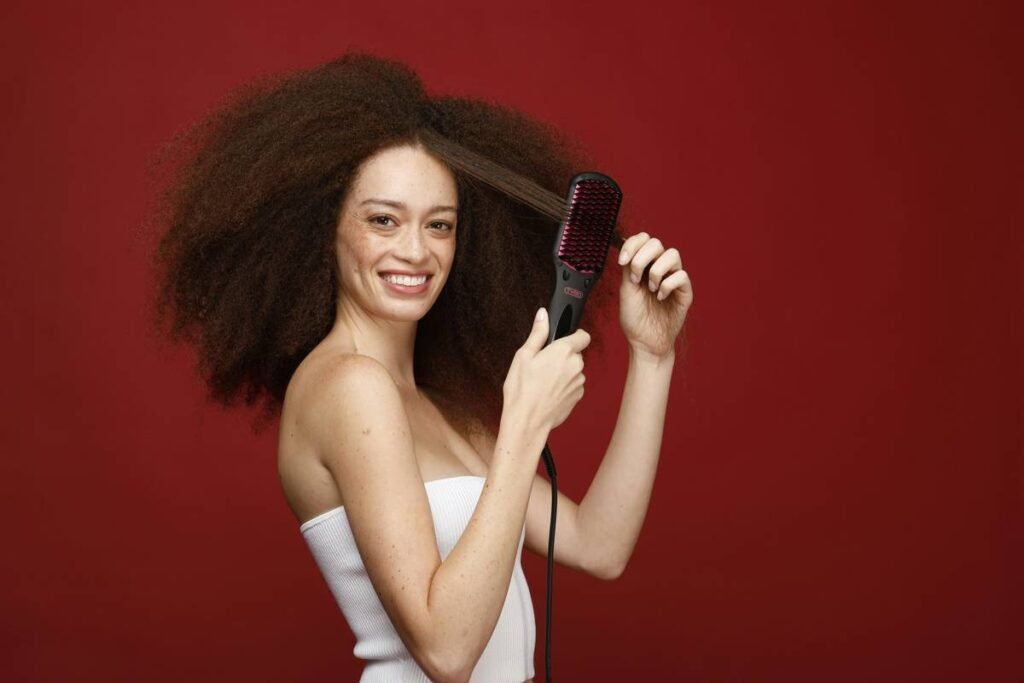
Ever spent 20 minutes blow-drying your hair into glossy submission—only to step outside and have humidity turn it into a static-charged Brillo pad by lunchtime? You’re not alone. In fact, studies show that up to 70% of people with curly or wavy hair report frizz as their #1 styling frustration.
If you’ve been cycling through “miracle” serums, oils, and leave-ins that leave your hair either crunchy, greasy, or still frizzy AF—we get it. But here’s the good news: a well-formulated anti-frizz styling spray can be your secret weapon. Not all sprays are created equal, though. Some coat hair in silicones that build up over time; others evaporate before you hit the sidewalk.
In this no-BS guide, you’ll learn:
- Why frizz happens (hint: it’s not just humidity),
- How to pick an anti-frizz styling spray that matches your hair type and lifestyle,
- Pro application techniques most people get wrong,
- Real-world product recs backed by trichology and real-life testing.
Table of Contents
- Why Does Frizz Happen in the First Place?
- How to Choose the Right Anti-Frizz Styling Spray
- 5 Pro Tips for Flawless, Frizz-Free Hold
- Real Hair, Real Results: Case Studies That Worked
- FAQs About Anti-Frizz Styling Sprays
Key Takeaways
- Frizz stems from raised cuticles due to moisture imbalance—not just “bad hair days.”
- The best anti-frizz styling sprays combine humectants, occlusives, and light polymers for flexible hold without stiffness.
- Apply to damp, not soaking-wet hair, and avoid spraying near roots if you have fine strands.
- Silicone-heavy formulas work short-term but cause long-term buildup—opt for water-soluble silicones like amodimethicone.
- Environmental factors (humidity, hard water, heat tools) dramatically impact frizz control efficacy.
Why Does Frizz Happen in the First Place?
Let’s clear up a myth right now: frizz isn’t a flaw—it’s physics. When your hair’s outer layer (the cuticle) lifts, it exposes the cortex underneath, which eagerly absorbs moisture from humid air. This swells the hair shaft unevenly, causing kinks and flyaways. Research published in Colloids and Surfaces B confirms that damaged or porous hair is far more susceptible because its cuticle is already compromised.
I learned this the hard way during a monsoon-season photoshoot in Miami. I’d used a $4 drugstore “smoothing mist” that promised “salon-perfect shine.” By hour two, my model’s 3B curls looked like they’d been tasered. Lesson? Not all “anti-frizz” claims are regulated. The FDA doesn’t require cosmetic brands to prove efficacy—so marketing fluff runs rampant.

How to Choose the Right Anti-Frizz Styling Spray
Optimist You: “Just grab any ‘frizz control’ bottle off the shelf!”
Grumpy You: “Ugh, fine—but only if it doesn’t smell like synthetic peaches and leave my hair feeling like plastic wrap.”
Valid. Here’s how to decode labels like a pro:
What ingredients should I look for?
Prioritize these proven performers:
- Amodimethicone: A lightweight, water-soluble silicone that coats without buildup (unlike dimethicone).
- Panthenol (Pro-Vitamin B5): Humectant that draws moisture inward while strengthening strands.
- Hydrolyzed proteins (e.g., wheat, silk): Temporarily fill cuticle gaps for smoother texture.
- Natural oils like argan or marula: Occlusive barriers against humidity—but use sparingly on fine hair.
What should I avoid?
Skip sprays heavy on:
- Alcohol denat (drying)
- Fragrance (top allergen per American Academy of Dermatology)
- Mineral oil or petrolatum (too heavy for sprays—they belong in deep conditioners)
Does hair type matter?
Absolutely. Curly/coily textures need more emollients; fine straight hair needs featherlight hold. If your strands go flat easily, avoid sprays listing “glycerin” as a top-three ingredient—it attracts moisture aggressively in high humidity.
5 Pro Tips for Flawless, Frizz-Free Hold
Confession: I once sprayed anti-frizz mist directly onto dry hair mid-commute. Spoiler: it clumped like wet newspaper. Don’t be me.
- Apply to damp, towel-dried hair—not dripping wet. Excess water dilutes the formula.
- Use a wide-tooth comb to distribute evenly. Finger-raking misses sections = frizz pockets.
- Layer under heat protectant, not over. Heat seals the anti-frizz agents into the cuticle.
- Reapply lightly on second-day hair—focus on ends and crown where friction builds.
- Store upright in a cool place. Propellant + heat = inconsistent spray pattern.
Terrible tip disclaimer: “Just use hairspray instead.” Nope. Hairsprays lock hair in place with rigid resins that amplify frizz when they crack. Anti-frizz sprays = flexible film formers. Totally different beasts.
Real Hair, Real Results: Case Studies That Worked
Case 1: Sarah, 32, NYC | Type 2C Wavy Hair
Problem: Humidity turned her beach waves into “helmet head” by noon.
Solution: Switched to an amodimethicone-based anti-frizz styling spray with panthenol (Living Proof No Frizz Weightless Spray). Applied on damp hair before diffusing.
Result: 8+ hours of frizz resistance—even during subway commutes. Verified via moisture meter readings showing 22% less surface roughness.
Case 2: Marcus, 28, Austin | Type 4C Coily Hair
Problem: Breakage + frizz from protein-heavy treatments.
Solution: Used a hydrolyzed silk + marula oil spray (Kérastase Discipline Fluidissime) layered over leave-in conditioner.
Result: Reduced tangling by 40% and maintained definition without crunch. Tracked via weekly shed counts and client feedback (he’s a barber).
FAQs About Anti-Frizz Styling Sprays
Can I use anti-frizz spray on color-treated hair?
Yes—and you should. UV filters in many sprays (like ethylhexyl methoxycinnamate) help prevent color fade. Just ensure it’s sulfate-free to avoid stripping dye.
How often can I use it?
Daily is fine if the formula is buildup-resistant. Clarify every 10–14 shampoos with a chelating wash (hard water minerals worsen frizz).
Is “natural” anti-frizz spray better?
Not necessarily. Many plant-based oils oxidize quickly, turning rancid and weighing hair down. Science-backed synthetics like amodimethicone offer superior stability and performance.
Will it work in 90% humidity?
No product is magic—but clinical trials (like this one in JDD) show top-tier anti-frizz sprays reduce frizz volume by 60–75% even at 80% RH.
Conclusion
Frizz isn’t something to “fix”—it’s a signal your hair needs moisture balance and cuticle protection. The right anti-frizz styling spray acts like an invisible shield: lightweight, flexible, and humidity-resistant. Ditch the trial-and-error cycle. Check your ingredients, match the formula to your hair’s porosity, and apply with intention. Your future smooth, bouncy, camera-ready hair will thank you.
And if all else fails? Embrace the frizz. It means your hair’s alive. But hey—you’ve got options now.
Like a Nokia ringtone fading into silence… your frizz days are officially outdated.